

The Science Behind Mane Reclaim
The 10 Nutrients Your Body Runs Out Of When You're Losing Hair on a GLP-1
Ozempic, Wegovy, Mounjaro, and Zepbound don't poison your follicles. The rapid caloric drop drains a specific set of nutrients — the same ones bariatric surgeons have been replacing for 40 years. Here's the full list, what each one does, and how to actually put them back.
If you started a GLP-1 and your hair started falling out three to five months in, you are not imagining it, and it is not random.
The drug molecule doesn't touch your follicles. What it does is shrink your appetite — dramatically. Most women drop from around 2,200 calories a day to 800 or 1,000 in the first 90 days. When intake falls that fast, your body runs a triage: it keeps funding the organs that keep you alive and stops funding the ones it considers optional. Hair is the first thing on the optional list.
This is a documented shed pattern called telogen effluvium — the same one that shows up in roughly half of bariatric-surgery patients, for the exact same reason. The good news buried in that comparison: bariatric patients almost always get their hair back, because their surgeons hand them a nutrient repletion list that's been refined for four decades.
Your follicles aren't dead. They've been deprioritized — on strike, waiting to be restocked. This is the list of what they're waiting for.
- Biotin (B7)
- Iron / Ferritin
- Zinc
- Vitamin B12
- Iodine
- PABA
- Pantothenic Acid (B5)
- Marine Collagen
- Vitamin D
- Vitamins A, C, E + Folate
BiotinVitamin B7
The one everyone reaches for first — and the one that disappoints most.
Biotin is a cofactor for the enzymes that build keratin, the structural protein your hair is made of. It's the ingredient in every drugstore hair gummy, and it's the first thing women on the shot buy.
Here's the catch: biotin only does something if you're actually deficient in it. Most American women aren't — which is why a standalone 10,000 mcg biotin tablet usually does nothing for GLP-1 shedding. The shed isn't a biotin problem in isolation. It's a multi-nutrient problem, and biotin is one line on a long list. Worth including at a real dose, useless as a solo act.
Iron / FerritinStored iron
The number your doctor checks — and the one that crashes hardest on the shot.
Ferritin is your stored iron, and it's one of the most important markers for hair growth that exists. Follicles are among the most metabolically demanding tissues in the body, and they lose access to iron early when stores fall. Many dermatologists want to see ferritin above 50 ng/mL for healthy growth; a lot of shedding women are sitting well below that.
GLP-1s make this worse fast, because red meat is one of the first foods to fall off the plate — early fullness and protein aversion are common. Less red meat means less heme iron means dropping ferritin.
This is the one nutrient we deliberately left out of Mane Reclaim — on purpose. Therapeutic iron doesn't belong in a gummy. It oxidizes, it tastes metallic, and unmonitored iron is genuinely risky (it's the leading cause of pediatric supplement poisoning, and iron overload is a real condition). The right move is to get your ferritin tested and, if it's low, take a targeted iron supplement separately, monitored by your doctor. Any hair gummy bragging about the iron inside it is telling on itself.
ZincTrace mineral
Runs the follicle's repair crew.
Zinc drives the protein synthesis and cell division that the hair growth cycle depends on. Zinc deficiency is a well-documented trigger for telogen effluvium — the same shed pattern GLP-1s cause. It also supports the immune and tissue-repair functions that take a back seat during rapid weight loss.
Like iron and B12, zinc comes mostly from meat, shellfish, and legumes — exactly the foods that shrink in volume on a GLP-1. You're not eating badly; you're just eating far less, and the trace minerals go first.
Vitamin B12Cobalamin
The follicle's fuel line.
Hair follicle cells are among the fastest-dividing cells in your entire body — and that kind of rapid division is impossible without adequate B12. When B12 runs short, the follicle's growth engine stalls and more hairs slip into the resting phase.
B12 comes almost exclusively from animal foods: meat, fish, eggs, dairy. That's the precise food category that contracts on the shot. GLP-1s also slow gastric emptying, which can blunt how well you absorb what B12 you do eat.
IodineThyroid substrate
The thyroid layer almost every hair supplement skips.
This is where Mane Reclaim's logic departs from the rest of the supplement aisle. Iodine is the raw material your thyroid uses to make thyroid hormone, and thyroid hormone — specifically T3 — sets the pace of your hair growth cycle. Low thyroid output means slower follicle cycling, which means more hairs sitting idle in the shedding phase.
Caloric restriction suppresses T3 directly — it's a survival response, your body slowing a metabolism it can't afford to fund. On top of that, modern GLP-1 eating patterns often cut iodized salt, dairy, and seafood, dropping iodine intake at the worst possible moment. Open up Nutrafol, Viviscal, or any drugstore hair gummy and you'll find the thyroid pathway almost entirely ignored. Bariatric protocols never ignored it.
PABAPara-aminobenzoic acid
The forgotten 1941 compound almost no modern formula includes.
PABA is a B-complex–adjacent compound with a genuinely strange history. In 1941, the American physician Dr. Benjamin Sieve published what's widely cited as the first documented study on hair using PABA, reporting that subjects regained hair color and apparent strength. By 1942 he had expanded the cohort to roughly 460 subjects. A 1946 patent summarized that about 82% of his subjects responded favorably at doses between 50 and 600 mg per day.
Then, after about 1950, the research went quiet — an 80-year gap. PABA got reclassified in the popular mind as "the original sunscreen ingredient," and its B-vitamin role in folate metabolism and hair was largely forgotten by the supplement industry. It's in Mane Reclaim because the formula was built from the historical clinical record, not the current supplement-aisle consensus.
A note on evidence: the PABA hair research is mostly mid-20th-century work, not modern randomized trials. We include it for its documented history and mechanism, not as a guaranteed outcome.
Pantothenic AcidVitamin B5
PABA's historical partner.
B5 supports energy metabolism in fast-dividing cells through its role in coenzyme A, and it's long been associated with hair and scalp health. It's worth knowing that the 1940s researchers frequently paired pantothenic acid with PABA — the two were studied together, which is why they appear together here.
Marine CollagenStructural protein
The raw building material.
Collagen supplies amino acids like proline and glycine that serve as building blocks for the keratin structure of hair. Marine collagen is favored for its bioavailability. On a GLP-1, with total protein intake down, giving the follicle targeted structural protein helps make sure there's raw material to actually rebuild with — not just signals telling it to grow.
Vitamin DFat-soluble vitamin
The follicle-cycle regulator.
Hair follicles carry vitamin D receptors, and vitamin D plays a role in cycling the follicle from rest back into active growth. Low vitamin D is associated with telogen effluvium and other diffuse shedding patterns — and vitamin D insufficiency is already widespread before anyone starts a GLP-1, so a reduced, lower-fortified-food diet only compounds it.
Vitamins A, C, E + FolateThe supporting cast
The cofactors that make everything else work.
Vitamin A helps regulate the follicle cycle and sebum — though it's a balance, since megadoses can paradoxically trigger shedding, which is exactly why a measured dose beats a heroic one. Vitamin C is essential for collagen synthesis and helps your body absorb iron from food. Vitamin E is an antioxidant that supports scalp circulation and protects follicle cells from oxidative stress. Folate works alongside B12 in the cell-division pathway your fast-growing follicle cells live and die by.
None of these are headline ingredients. All of them are load-bearing — the difference between nutrients that get used and nutrients that get wasted.
Why this exact list, and not a generic hair vitamin
The reason this list looks different from what's on the shelf is that it didn't come from the hair-supplement industry. It came from bariatric medicine — the one field that's been managing sudden, dramatic caloric drops for 40 years.
Bariatric surgeons solved it with a refeeding-and-repletion protocol: protein, iron, zinc, B12, biotin, and — critically — the iodine for the thyroid layer that consumer hair supplements skip. That protocol works. The hair grows back.
Nobody had translated it for women on GLP-1s, because until recently GLP-1s weren't mainstream enough to justify the product. So women on the shot got handed Nutrafol — real science, but built for postpartum, menopausal, and hormonal hair loss, a completely different mechanism — and told to "give it time." That's why so many report spending hundreds with mixed results at best. It isn't that those products are bad. It's that they were built for a different problem.
Here's the problem with this list
Read back over what you'd actually need to buy: a real-dose biotin, a zinc, a B12, an iodine, PABA (good luck finding it), a B5, a marine collagen, a vitamin D, plus A, C, E, and folate.
That's ten-plus separate supplements. At the doses that matter, it's a fistful of pills a day — for a woman who's already dealing with GLP-1 nausea and was told the whole appeal was not having to white-knuckle her way through anything anymore.
And you'd have to get the ratios right, because some of these only work together, and at least one can backfire at the wrong dose (vitamin A).
This is exactly the assembly problem bariatric surgeons solved decades ago with a single protocol. So we did the same thing — for the shot.
- Biotin, B12, zinc, B5, folate, A, C, D, E✓ in the formula
- Iodine (the thyroid layer)✓ in the formula
- PABA — the forgotten 1941 compound✓ in the formula
- Marine collagen✓ in the formula
- Iron (belongs in a tested, monitored protocol)✕ deliberately out
- Saw palmetto (the facial-hair culprit in other brands)✕ deliberately out
- Megadoses for label theater✕ deliberately out
Mane Reclaim is the bariatric repletion protocol, rebuilt for the GLP-1 woman, in a gummy you take twice a day. Not four horse pills. Not a generic hair vitamin with the word "GLP-1" stuck on the label. The actual list above — assembled, dosed, and in one place.
The 90-Day Reclaim Bundle
Hair grows on a 90-day cycle, so 90 days is the honest minimum to judge any hair supplement. We back it with a 90-day money-back guarantee — don't see fewer hairs in your brush, drain, and pillow, and we refund you. Keep the bottle.
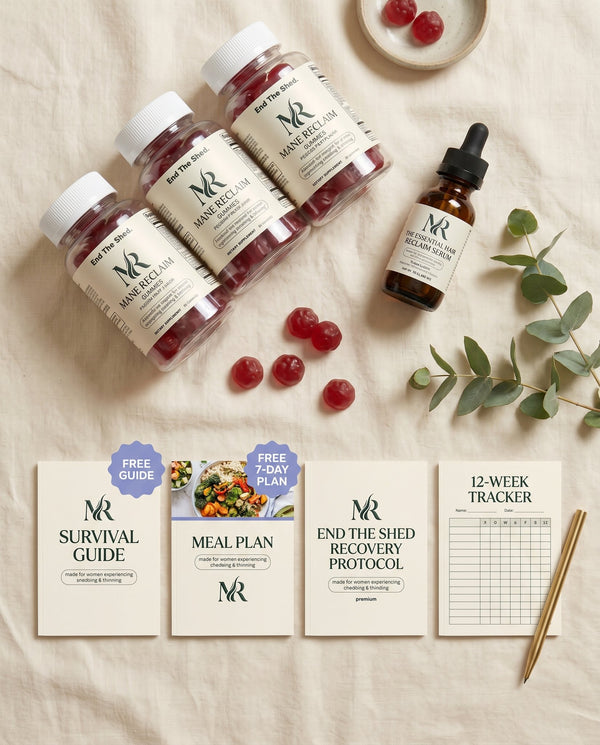
- ✓ 3 bottles of Mane Reclaim (40% OFF)$179.99
- ✓ Mane Reclaim Serum (FREE)$32.99
- ✓ End The Shed Protocol PDF$27
- ✓ 12-Week Recovery Tracker$17
- ✓ Free U.S. shipping$9
You earned the body.
You get to keep the hair.
Wanting your weight loss and your hair doesn't make you vain. It makes you someone who intends to keep the whole transformation. The nutrient list to do it has existed for 40 years. Now it's in one place.
Reclaim My Hair →*These statements have not been evaluated by the Food and Drug Administration. This product is not intended to diagnose, treat, cure, or prevent any disease.
This article is for educational purposes and is not medical advice. Nutrient depletion, hair loss, and thyroid function vary by individual. Talk to your healthcare provider before starting any supplement, especially if you have a thyroid condition, a kidney condition, or are pregnant or breastfeeding. Get your ferritin and relevant labs tested before supplementing iron.